
A short story of a writer lost and found in Japan
There comes a time in every life when we’re struck with the realization that every path we’ve taken thus far has been the wrong one. My time came on a sunny Thursday morning in May. I was sitting alone, sipping a Vietnamese coffee in a jungle-themed café at the far end of Inokashira Park, in the Kichijoji suburb of Tokyo. My notebook and laptop lay before me, white maws greedily open, waiting to swallow up any speck of creativity I may be able to shore up. The past few months had been scant, and they were severely underfed.
Despite living in Japan for over 12 years, my professional situation was still hard to describe. Basically, I worked any odd job that could squeeze a few yen out of the average Japanese salaryman’s linguistic insecurities. Online English lessons, translation, editing, YouTube classes, helping sharply-dressed tech execs enunciate their golfing slang; jobs I hadn’t known existed, let alone could support a single man in his late 30s. I wasn’t making enough to have any real savings, but plenty to cover rent and support my higher aspiration. The odd jobs were temporary. I was going to make it as a writer.
I’d had my whole journey planned out for over a decade. Start small with short stories and nonfiction articles. Build an audience. Support myself with freelance work. Then, gradually write longer form. Nail my debut novel. Find an agent. Get paid in dollars or pounds which, when converted into yen, would add up to a pretty decent living. And if things got rough, I could always go back to the salarymen. It all made so much sense on paper.
Making sense on paper was my strong suit. It’s how I got my degree, three or four life plans ago. In high school, my greatest interest was in the human mind. Specifically, how to persuade the minds of attractive people to go out with me. I was a simple man. Without much effort, I graduated with a B.A. in Psychology from a pretty decent university. Nowhere near Ivy League, but reputable enough for recruiters to raise their eyebrows, puff up their lower lip, and acknowledge me with a slow nod. Recruiters are predictable like that. I talked to a lot of them before moving to Japan. In fact, a recruiter ended up becoming one of my top reasons for moving. I remember the way he looked me up and down as if I were the world’s largest gourd, then smiled haughtily and declared, “You know, with your background, you would make a good recruiter.” Not the thing I was hoping to hear in a dreary colorless office, perched up on the 11th floor of one of San Francisco’s identical-looking downtown skyscrapers. The office wasn’t even his. The poor man worked from a cubicle. I wondered if that had ever been his plan.
The main flaw in my plan had been to assume that professional writing was mostly about writing. In my mind, there was this Platonic ideal called ‘good writing,’ and as long as I got close enough, I would necessarily become successful. Kind of like this discipline called ‘psychology,’ which anyone can learn, and will necessarily land you a stable job in recruiting.
But writing is different. It’s all-consuming. To produce writing that stands out, you need to become a person who stands out. And not in a cheap way. I tried parading around Tokyo wearing witty t-shirts and improbable hats. They did nothing for my creativity. You need to stand out in every facet of your human existence. Discover what makes you unique. Cultivate it. Wring the essence of your being down into your fingertips and bleed yourself dry onto the page. Then people might be interested in reading what you have to say.
Maybe. You’ll still be competing against millions of other writers from around the world. The best prize you can hope for is the few scraps of attention people have left over when they’re done with all things scrollable.
Such thoughts were my daily lot. Figuring out why I couldn’t possibly be successful was far easier and more satisfying than actually working to become successful. Failure always makes sense on paper. If only I’d been born into an artistic family. If only I’d pursued writing earlier in life. If only I’d had more talent. If only I’d chosen a more useful degree. If only I’d worked continuously on my craft, rather than spent thousands of hours learning Japanese. The crutch of rationalization had kept me standing for so long, I had come to think of it as an extension of myself. I was a jaded person. At least, until the gray man from Meikon yanked the crutch away, and mercifully, I fell.
But I’m getting ahead of myself.
***
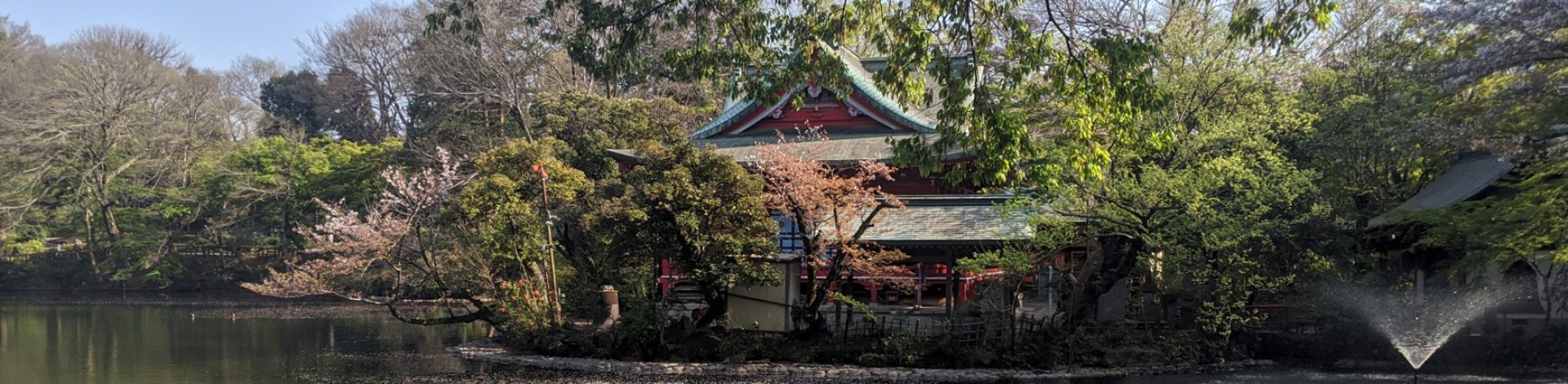
Inokashira park is by far the nicest patch of greenery for miles around the Kichijoji area. It’s hellishly crowded on weekends and holidays, unbearable during cherry blossom season, but on an average weekday morning, it’s an oasis of calm in the otherwise chaotic city. If only I had been left alone to enjoy the rustling leaves and cackling cormorants.
Ever since the country reopened for tourism, a small but rowdy group of online streamers had decided to make Japan their playground. They roamed around in small packs and filmed themselves insulting random strangers, yelling racist stereotypes, and breaking the law in whatever petty way their shallow minds could dream up. I knew my day was about to take a turn the moment I saw a well-dressed white boy—technically an adult, but over a decade my junior—dash across the bridge over Inokashira Pond with his cameraboy in tow.
At first I fancied myself safe from their malice. They were absorbed by the cormorants perched on a cypress tree overlooking the pond. The park had a recurring issue with bird feces, and the cormorants were by far the worst offenders. Park officials even tried to protect the central walkway by building a tent, but all that did was elevate the stench. Since all things excremental are a source of instinctive fascination for the primitive mind, the two streamers were drawn to the tent like colossal flies. The ringleader grabbed a long stick, scraped off some of the fresher guano, and proceeded to smear it against the walls of a nearby public restroom. Meanwhile, the cameraman hovered nearby, laughing maniacally.
Eager to escape the burgeoning storm of stupidity, I packed up my writing tools, paid the bill, and hurried out. Unfortunately, the exit from the café led back to the peripheral path around the pond, and closer to the boys. So many foreigners lived around Kichijoji, we had become part of the park’s ecosystem. I fancied myself as inconspicuous as a shrub. However, to the two ignorant and attention-starved youngsters, a tall overweight bearded bald white man stood out like a sore thumb on stubby legs. I tried my best to ignore their buzzing as they approached. The smaller one aimed his camera at me with sniperlike zeal. The taller one accosted me with the smarmy faux politeness typical of an offensively coddled upbringing.
“Sir! Excuse me, sir! You’re live on my channel right now. Are you from around here, sir? You’ve got 5,000 people watching you. Can I ask you some questions, sir?” In his high-pitched whine, he even sounded like a gnat.
I should have kept walking. Part of me screamed to keep my head down and carry on. But at the same time, I was transfixed by the wretched stick he was still holding. More people than had ever read any of my poetic endeavors were spending their time watching this hollow cavern of a man paint a prehistoric mural. The first descriptor to come to mind was ‘imbecile’, but the word derives from the Latin prefix ‘in’, meaning ‘without’, and ‘baculum’, meaning ‘stick.’ The man was a walking contradiction. He must have picked up on my fascination because, like a raccoon spotting a brimming trash can, he pounced.
“Sir, why are you walking around all by yourself on a Thursday morning? Are you unemployed, sir? Are you broke? Are you homeless?”
The onslaught was relentless. At a quickened pace, I headed for the upper area of the park, but I couldn’t outrun his vulturine determination.
“Are you hungry, sir? Would you like something to eat? I have a local delicacy right here. I’ll give it to you for free if you eat it on camera. Here you go, sir. Come on, have some!”
I felt the tip of his stick rub against the back of my jacket. The leather jacket I had gifted myself to celebrate ten years of living in Japan. The most expensive piece of clothing I had ever owned. I stopped again. Building up inside was an anger I had never experienced before. I couldn’t stop my shoulders from shaking. My body grew warm and my breath heavy, like an engine pushed into overdrive. I tried to calm myself. He was young and stupid, making the most of a world amused by youthful stupidity. I was the mature adult, and morally compelled to act accordingly. If he had given me a few moments of uninterrupted silence, I might have been able to control myself. I might have been able to make sense of my emotions. I might have done what was best on paper.
But he persisted.
“Sir, your jacket stinks! When’s the last time you washed it? Are you too broke to wash your clothes, sir? When’s the last time you showered?”
With all my weight hinging on my left heel, I swerved and swung. Behind my blow was a pent up fury I didn’t know I’d been harboring. I felt a sweltering rage at his lack of decency, at his upbringing, at the society empowering him to dehumanize and humiliate people he had never met. My steaming heartbeat filled me with a searing hate for those 5,000 bystanders. Those faceless parasites with no craving for higher culture, no intellectual curiosity, and no drive toward self-actualization. They were the problem. He was the problem.
And I was the problem. For not knowing better. For not ignoring him, or choosing a more civilized response. Regret and self-loathing kicked in the instant my fist connected with his jaw.
I wasn’t a violent person. Until that day, I had never so much as pushed another person over. But I was a big man, and my loose schedule left me with time to burn at the local 24-hour gym. I closed my eyes as my right knuckle collided with warm, soft flesh. A nearby bush rustled violently as it caught his tumbling body. The cameraboy screamed, lowered his camera, and rushed to help his friend. I bolted.
The next few minutes were a blur. I ran up the hill out of the park, looking over my shoulder frantically to make sure I wasn’t being followed. Thankfully, my assailants—I’ll let you judge if that’s the right word—showed no interest in pursuing me. I pulled a handkerchief out of my jacket pocket to wipe the scattered splatters of blood and snot from my hand. A few red stains on my white sneakers almost brought on a panic attack, but I managed to keep my head down and zip into the nearest convenience store. Before the unnervingly chipper cashier, I set down a packet of wet wipes and a 100 yen bottle of jasmine tea. Buying several items somehow felt less incriminating. He barely had time to ask me if I needed a bag before I was back out on the street.
My immediate thought was to get as far away as possible. On the opposite side of the intersection leading to Kichijoji train station, two police officers were chatting with a senior citizen. I tried to look as natural as possible, standing with my left foot over my right shoe to cover up the bloodstains. The moment the light turned green, I made a diagonal away from the officers, into the station department store, up the escalator to the access level, and into the station proper. An express train bound for Mount Takao would be arriving in a minute. I strode up to the westernmost edge of the platform, and when my ride arrived, I hopped on.
***
This is an excerpt of a short story I recently wrote for Medium. You can find the link to the full story here.
 The Foreign Rational